Customer Cases / Industrial IoT

A Heavy Machinery Group

Data Migration and SCADA System Database Upgrading

Contact Us
Data Aggregation
2–8x higher writing throughput
10%–30% faster query & analysis

Business Background

As a golablly renowned automotive and equipment manufacturer, the heavy machinery group has seven business segments, including powertrain, commercial vehicles, construction machinery, and intelligent logistics, leading the world in production and sales volume with engines, heavy-duty trucks and gearboxes.

Under digital transformation for equipment manufacturing, the group has implemented SCADA (Supervisory Control and Data Acquisition) system to mainly support production data collection, data distribution, and data analysis.

Data Challenges

Facing complex industrial sites and massive heterogeneous data, traditional architectures encounter serious bottlenecks in performance, cost, and intelligence

01

Difficulties in Unified Data Collection and Storage

The production environment involves diverse data types such as time-series and relational data, as well as multiple protocols including Modbus and LoRa, leading to the difficulties in unified data collection, storage and management.

02

Weekness in Data Utilization

Collected data in acquisition systems is barely stored but rarely used, and there is a significant delays in data display, making it impossible for decision-making support.

03

High O&M Costs

The original SCADA system uses multiple databases to handle multi-model data, leading to limited performance scalability, high O&M labor costs and expensive storage.

04

Challenges in Work Hour Statistics

Equipment operation relies on manual statistics, with potential falsification of working hours and lack of transparency in production processes.

05

Difficulties in Production Schedule Evaluation

Equipment utilization and labor workload lack reliable data support, resulting in low scheduling accuracy and limited production capacity.

06

Challenges in Equipment Fault Prediction

Insufficient data analysis leads to unreasonable maintenance scheduling, fail to prevent unexpected equipment failures, and further restrictions on production capacity.

KaiwuDB Solution

Multi-Protocol Integration

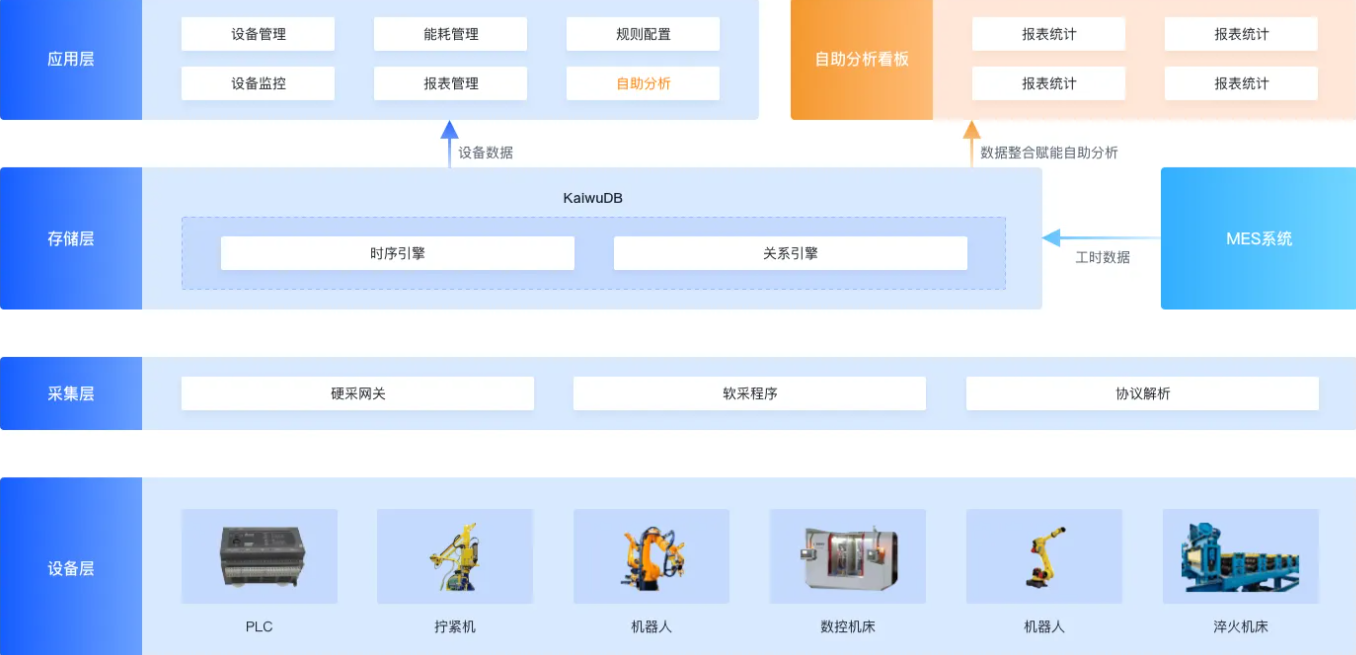
Based on KaiwuDB multi-model database, we have built a unified data platform that supports multi-protocol access, enabling multi-source heterogeneous data acquisition, and seamless migration of historical data.

Simultaneous Data Ingestion and Analysis

With edge computing and real-time analytics powered by KaiwuDB and KDP, the system achieves high-speed data storage and real-time analysis, supporting effective production decisions.

Multi-Engine & Elastic Scaling

KaiwuDB integrates adaptive time-series, relational and analytical engines, enabling 'one database, multiple capabilities' to reduce O&M costs. It also supports elastic scaling to meet data growth needs when production line expansion.

Production Line Data Analysis

Operation data from workstations is collected, stored and analyzed to accurately evaluate working hours and equipment status, improving productivity and efficiency.

Intelligent Production Scheduling

Production data is analyzed on KDP to evaluate capacity and efficiency across lines, supporting reasonable scheduling and avoiding delivery delays.

Equipment Failure Early Warning

A early warning mechanism based on KaiwuDB and KDP accurately predicts risks such as equipment overload, supports rational maintenance scheduling, and avoids unplanned downtime and excessive labor input.
Heavy Industry Group SCADA Transformation Solution Architecture

Client Benefits

Simplifing Architecture with Multi-model Capability

Eight billion historical records on the original system were smoothly and uniformly migrated to KaiwuDB, where the multi-model architecture enables'one database, multiple capabilities'.

Improving Data Writing Performance

More than 5,000 devices are connected, supporting efficient writing of over 100 million new records per day across dozens of data types. Data writing performance of the SCADA system has been improved by 2–8 times.

Comprehensive Data Integration

Data is fully collected across all production processes. Production and operational data are correlated to enable efficient collaboration and higher productivity.

Data Analysis for Cost Reduction and Efficiency Improvement

The system delivers efficient data read/write, supporting complex data aggregation and real-time data analysis. Query and analysis performance is improved by 10%–30% across scenarios. Unexpected downtime is reduced while equipment utilization significantly enhanced.

Unlock Your High-Performance IoT Data Management Experience with One Click