Industrial IoT
delivers high-throughput and precise data collection, multi-model data integration, edge-to-cloud data collaboration, and AI predictive analytics for smart manufacturing and digital factories. It strengthens customers' digital infrastructure to reduce costs and boost efficiency.
Industry Pain Points
Difficulties in Processing Massive Time-Series Data
Industrial worksites are equipped with numerous PLCs, industrial sensors, and intelligent measurement and control devices, generating millions to tens of millions of time-series data per second. These data require extremely high acquisition accuracy — at millisecond, microsecond, or even nanosecond level —and impose enormous pressure on concurrent writing.Traditional solutions cannot support high-throughput, low-latency data collection and real-time processing, often leading to data loss and processing delays. This directly affects the stability and accuracy of core businesses such as equipment monitoring and production scheduling.
Poor Capability in Multi-model Data Integration
MES, ERP, EMS and other IT systems are extremely isolated from PLC, SCADA and other OT systems, forming 'data silos'.Meanwhile, industrial scenarios involve multi-modal data such as equipment vibration data(time-series data), account and process text parameters(relational data).Traditional databases only support a single data type and lack the capability for unified storage and associated analysis of multi-modal data, making it difficult to achieve cross-modal data integration.
Lack of AI-powered Business Process
Industrial data is expected to support core businesses such as fault prediction, production efficiency analysis, and yield improvement. However, traditional databases only provide basic storage and query functions, lacking capabilities for model training and predictive analysis. In addition, there are no intelligent components like AI agents that can automatically perceive, analyze, and make decisions.Therefore, 'data accumulated, but not utilized', which means massive time-series data cannot be transformed into actionable decisions, due to the lack of AI-powered business process of 'data collection – analysis – decision – optimization'.
Limited Performance on the Edge
Massive time-series data generated by industrial equipment such as robots, CNC machines, and tightening machines requires millisecond-level local real-time computation and control.However, traditional centralized databases cannot be deployed at the edge nodes, which are mostly resource-constrained devices like embedded systems and industrial PCs, while local lightweight databases struggle to support complex real-time analysis.This results in slow on-site decisions and delayed remote feedback, which directly impacts production rhythm and product yield.
Full-link Industrial Data Processing Solution
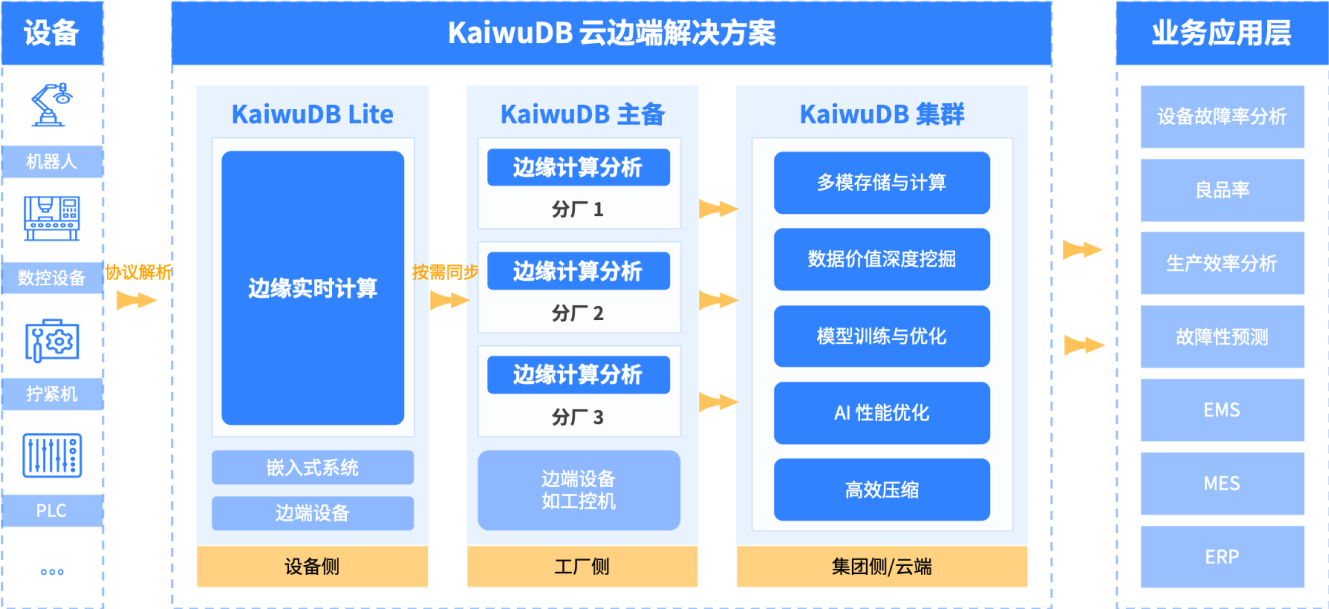
For large industrial sites with dispersed assets, massive data, high-precision collection demands, and multi-tiered decision-making, we have built a three‑tier cloud‑edge‑end architecture centered on KaiwuDB, and established a full‑link industrial data processing system for the Industrial IoT (IIoT).

Leveraging KaiwuDB’s core technologies such as in‑data computing, stream computing, pre‑computing, and clustered deployment, we efficiently solve the key challenges of high‑throughput writing and collection of massive time‑series data at the industrial edge side.
Through KaiwuDB clusters, we deliver ultra‑fast aggregate query and analysis capabilities. Combined with our AI agent tool KAT, we build a high‑efficiency data analysis system to provide reliable and timely decision support for production data analysis and business decision‑making at all levels of branch plants and headquarters.
On the end side, KaiwuDB Lite is embedded into systems and devices. For high‑precision time‑series data (millions to tens of millions of points per second, at millisecond/microsecond levels) generated by PLCs, industrial sensors, and intelligent measurement and control equipment, it provides high‑throughput, low‑latency real‑time collection and edge computing capabilities, eliminating data loss and processing delays and ensuring the stability and accuracy of core services such as equipment monitoring and production scheduling.
At the branch factory, KaiwuDB is deployed in primary‑standby mode to undertake edge computing and analysis tasks. It performs local aggregation of time‑series data including equipment vibration, temperature, and pressure for anomaly detection and process parameter optimization. Thus, enabling real‑time analysis of production efficiency, yield, and other indicators, as well as on‑demand data synchronization, while releasing concurrent write pressure.
The KaiwuDB cluster in headquarters provides multi-model storage, model training, and AI optimization. Combined with our AI agent KAT, KaiwuDB supports data mining and forms the process of "collection – analysis – decision – optimization". With high-efficiency compression and hot-cold tiered storage, KaiwuDB enables hundreds of millions of data points collection, the integration of EMS, MES, ERP and other systems, and industrial digitalization.
Solution Value
High-throughput and Accurate Data Collection
KaiwuDB's core techniques including edge computing, stream computing and pre-computing enable efficient processing of massive time-series data from industrial PLCs, sensors and intelligent measurement & control devices. This solution supports one million data point writes per second and 10-billion-record aggregate queries, while reducing query response time to millisecond-level.
Multi-modal Data Aggregation
This solution forms a data link between IT systems such as MES, ERP and EMS, and OT devices including PLC and SCADA, eliminating data silos. It supports the unified storage and correlation analysis of multi-modal data, such as equipment vibration(time-series data), standing books(structured data), and craft text(graph and other data). The solution enables integrated modeling to meet the cross-system collaboration requirements for production optimization, quality traceability and other scenarios.
AI-powered Data Mining
Based on high-performance KaiwuDB, the solution supports high-concurrency writing, efficient storage and querying of massive time-series data, laying a solid foundation for data mining. While our AI agent KAT enables automatic data perception, decision-making, model training and predictive analysis. With above capabilities, the solution converts massive data into actionable business decisions, and forms a complete AI-powered business process, empowering fault prediction, OEE optimization, yield improvement, and more scenraios.
Edge-to-Cloud Collaboration
Adapted to resource-constrained scenarios such as edge embedded systems and industrial PCs, this solution enables millisecond-level local real-time computing and control on robots, CNC equipment and other devices, ensuring production rhythm and product yield. Established an on-demand data synchronization mechanism among device, branch factories and headquater, efficiently processed massive time-series data from PLCs and sensors. Data flow and storage costs are precisely controled, realizing cross-level production scheduling and overall optimization.