Energy & Power
Against the backdrop of the 'dual carbon' goals and the construction of new power systems, the energy and power industry is accelerating digital transformation. Facilities such as smart grids, new energy power stations, and energy storage systems generate massive amounts of high-frequency time-series data (voltage, current, power, equipment status, etc.). The industry faces core pain points: poor data write performance leads to delays in real-time monitoring and slow historical data queries, affecting grid dispatch, fault warning, and new energy accommodation capability. Therefore, efficient time-series data management has become the technical cornerstone of the digital transformation of energy and power — it directly affects the real-time performance and reliability of key scenarios such as safe and stable grid operation, new energy grid integration and consumption, and predictive equipment maintenance, serving as the foundational capability supporting the construction of new power systems.
Industry Pain Points
Difficulty in Ensuring Real-Time Data Collection
Time-series data in the energy and power industry comes from multiple scenarios such as wind, solar, storage equipment, grid facilities, and user meters, with collection frequencies at the second/minute level. Issues such as heterogeneous device protocols, unstable signals in remote areas, and data loss under extreme operating conditions make it difficult to ensure full-link data real-time synchronization and consistency, affecting the accuracy of dispatch and maintenance decisions.
Triple Load of Data Storage, Computation, and Backtracking
The entire process of power production and consumption generates massive amounts of high-concurrency time-series data daily. Traditional architectures struggle to support high-concurrency writes and long-term low-cost storage needs. Meanwhile, scheduling optimization and load forecasting require millisecond-level real-time computing, while fault tracing and compliance audits require efficient historical backtracking. These three overlapping demands create a significant technical load.
Difficulty in Transforming Business Data Value
Massive time-series data such as equipment operation and energy consumption monitoring are isolated from business systems like EMS. There is a lack of algorithm models adapted to power scenarios (fault prediction, peak shaving scheduling, renewable energy output forecasting). Data is 'stored but not used', making it difficult to transform into precise decision support for production operations through trend analysis and anomaly identification.
High Requirements for Data Compliance and Security
At the data level, there are governance challenges such as inconsistent standards, missing metadata, and numerous outliers, affecting data usability. At the same time, the data involves core grid operation information and user privacy, requiring compliance with local storage, transmission encryption, and permission control. Balancing data security with efficient business operations has become a key pain point.
Integrated Energy & Power Solution
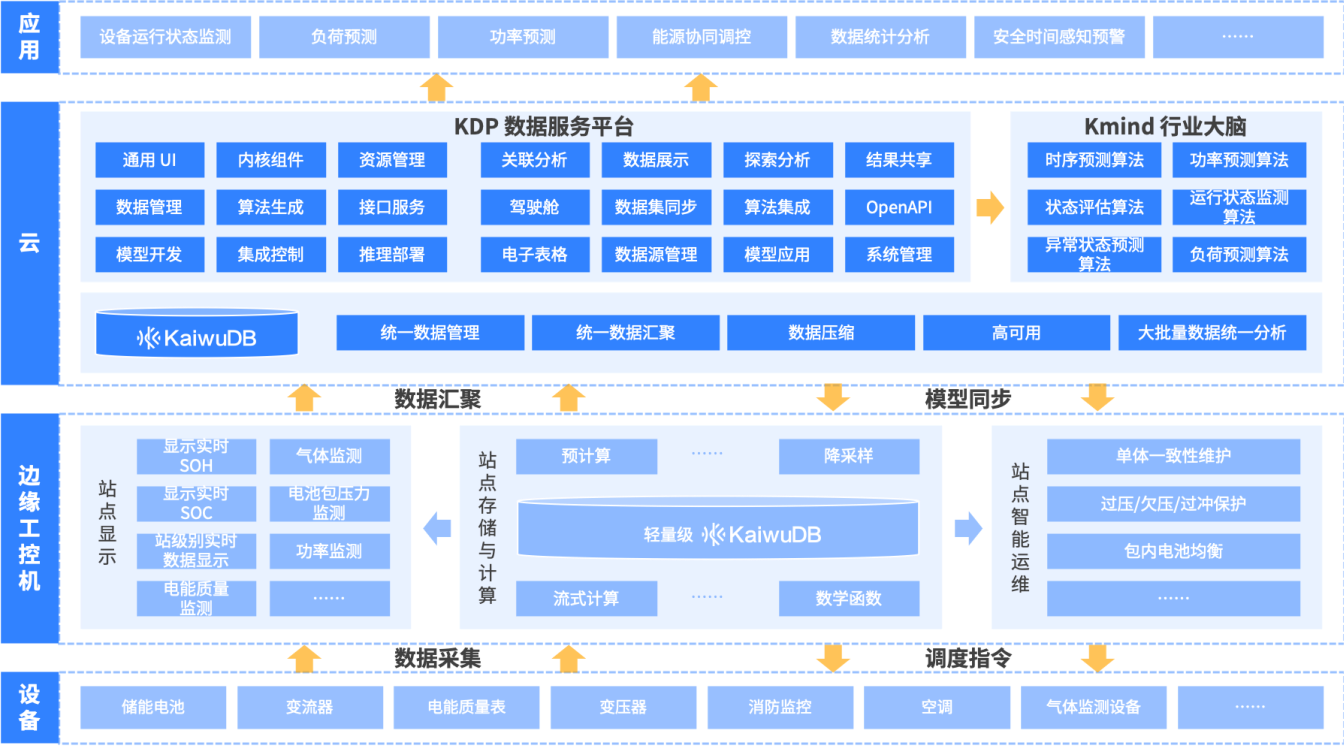
Aiming at the four core challenges of the energy and power industry — poor real-time consistency of time-series data collection, high load of storage/computation/backtracking, insufficient integration of business value transformation, and difficulty in balancing governance, compliance, and security — we have created an integrated solution with KaiwuDB as the core time-series data foundation, connecting the Inspur Kaiwu Industry Digital Intelligence Brain (K-mind) and the Data Service Platform (KDP). KaiwuDB leverages its native time-series database technical features to solve the core problems of multi-source data real-time collection, massive time-series data storage/computation/backtracking. By linking data pipelines with K-mind, it enables power scenario algorithm modeling and value transformation. Linking with KDP completes full-link data governance, while built-in fine-grained security management capabilities fully adapt to the full lifecycle management needs of time-series data in the energy and power industry.

Solution Value
Significantly Improved Data Consistency
Leveraging KaiwuDB's adaptability to mainstream power industry protocols such as Modbus and OPC UA, combined with real-time data validation, resumable transmission, and consistency synchronization mechanisms, it solves pain points such as asynchronous data collection from multi-source heterogeneous devices, unstable signals in remote areas, and data loss under extreme operating conditions, providing a reliable data source for subsequent data processing and business applications.
Substantially Improved System Performance
KaiwuDB's distributed architecture supports high-concurrency writes at millions of QPS. Hot-cold tiered storage reduces long-term archiving costs. The millisecond-level aggregation computing engine and dedicated time-series indexes improve processing efficiency, effectively addressing the challenges of massive time-series data storage pressure, slow real-time computing response, and inefficient historical backtracking, meeting the needs of core scenarios such as power dispatch optimization and fault tracing.
Unlocked Data Value Transformation Pipeline
Using KaiwuDB as the unified time-series data foundation, standardized equipment operation and energy consumption monitoring data are seamlessly connected to the Inspur Kaiwu Industry Digital Intelligence Brain. Through industry-specific algorithm templates, it solves the pain point of shallow integration between data and business scenarios (data 'stored but not used'), transforming it into precise decision support for fault prediction, peak shaving scheduling, etc., achieving a closed loop from data to business value.
Balanced Data Governance and Compliance
With the KaiwuDB data governance platform, it completes power time-series data standard unification, metadata management, and data quality cleaning. Combined with KaiwuDB's fine-grained permission control, transmission encryption, and operation auditing capabilities, it solves the dual challenges of chaotic data standards, uneven quality, and high security/compliance risks. It not only improves data usability but also meets the requirements for core grid data protection and user privacy compliance.