Industry Solutions

Internet of Vehicles (IoV)

caters to smart transportation, intelligent connected vehicle (ICV) R&D and testing, and other scenarios. It delivers high-throughput data ingestion, low-latency queries, cost-effective storage and predictive analytics, providing precise data support for vehicle monitoring, driving behavior analysis and vehicle-road collaborative decision-making.

Industry Pain Points

Weekness in Multi-model Data Writing

Data acquisition terminals on vehicles integrate a wide range of core data sources. For example, vehicle GPS data requires real-time collection of longitude, latitude, speed, heading, and other parameters, typically sampled at 1–10 Hz. With numerous data points and high-frequency sampling, a single vehicle can generate data volumes ranging from KB to MB per second. In fleet management scenarios, simultaneous data uploads from hundreds or even thousands of vehicles result in massive concurrent write requests.However, traditional relational databases are not designed for time-series data and lack efficient mechanisms for optimized batch and sequential writes. Under high-frequency concurrent writes, queue congestion and I/O bottlenecks can easily occur, leading to data ingestion delays of seconds or even minutes, which directly causes a series of business problems.

High Data Storage Costs

Data in Internet of Vehicles (IoV) scenarios is mostly time-series data and keeps growing rapidly. The daily data volume of mainstream IoV platforms usually reaches terabytes (TB). Some large autonomous driving test platforms and nationwide fleet management platforms even generate more than 10 TB of data per day. After long-term operation, these platforms form huge data repositories at the petabyte (PB) level.Traditional database(like MySQL) systems use the same storage devices (such as SSDs and HDDs) and same storage policies for both new and old data, leading to two major problems:First, hardware costs and database operations costs increase significantly.Second, large amounts of old data take up high-performance storage resources for a long time, resulting in a waste of storage resources and difficulties in data backup and migration.

High Requirements for Data Analysis

IoV data analysis scenarios mainly fall into the following three categories.First, real-time analysis scenarios, including real-time vehicle monitoring and abnormal behavior early warning. These require millisecond to second-level fast analysis of real-time data to avoid decision-making errors.Second, offline analysis scenarios, such as vehicle fault tracing and driving behavior analysis. These need to support batch analysis and aggregate computing of PB-level massive time-series data, with efficient multi-dimensional query and time-series correlational analysis.Third, machine learning scenarios, mainly used for autonomous driving algorithm training and fault prediction model optimization. These require efficient extraction of time-series features to support fast reading and batch processing of massive time-series data, ensuring model training effectiveness.

IoV Time-series Data Full-Lifecycle Management Solution

Addressing challenges such as high-frequency massive writing, multi-dimensional offline/online analysis, and the surge of historical data in the IoV industry, we use KaiwuDB as the core time-series data engine to build an integrated data foundation from terminal-side collection and edge cleaning to central cloud analysis, empowering the digital upgrade of IoV businesses.

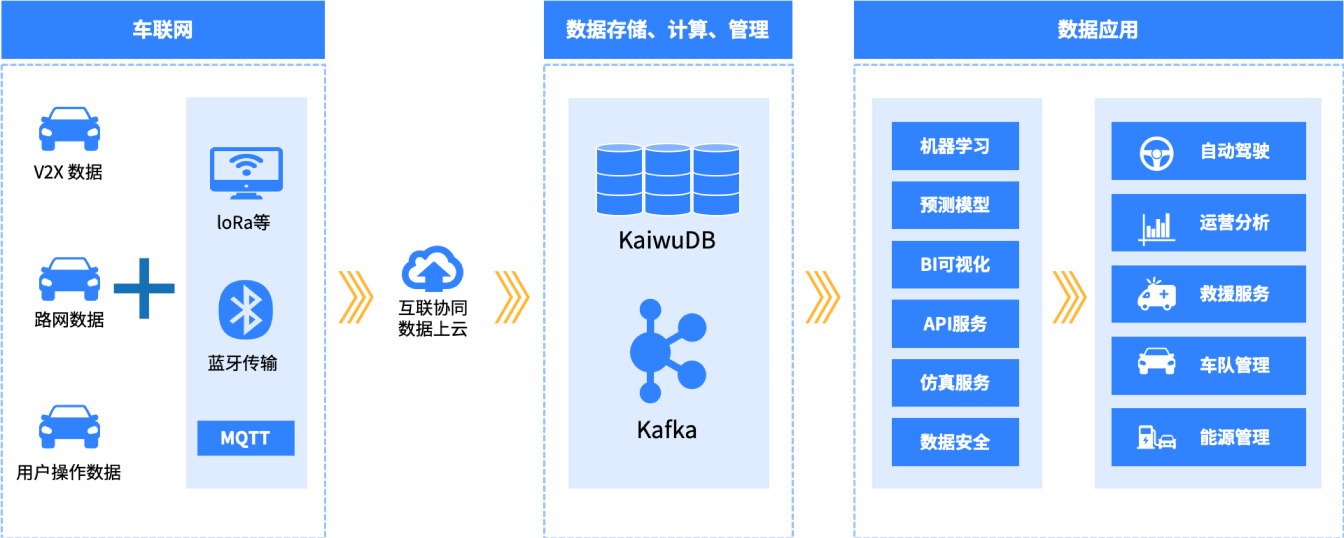
IoV Solution Architecture
1

KaiwuDB provides a professional time-series data engine designed for high-concurrency writing, efficient storage and in-depth analysis of massive vehicle time-series data. It delivers stable, efficient and cost-effective data support for upper-layer business systems, empowering the digital transformation of IoV businesses.For diverse vehicle-side time-series data—including real-time driving status from sensors (speed, tire pressure, steering angle), central control system operation data, and core engine and powertrain data (speed, fuel consumption, water temperature, fault codes)—the system uses the MQTT protocol and 5G networks to achieve low-latency, highly reliable transmission. This ensures high-speed data ingestion from vehicle terminals to the storage layer, guaranteeing real-time and complete data delivery to meet the high-frequency collection and massive reporting requirements of IoV scenarios.

2

Vehicle time-series data is aggregated, cleaned and standardized through edge gateways before being uniformly connected to KaiwuDB. The database enables centralized storage, standardized management and integrated computing, establishing a full-lifecycle management system for IoV time-series data.To fit time-series data writing and query patterns, we optimized KaiwuDB's storage structure and processing mechanisms, greatly improved write throughput and storage efficiency. With refined data policies, it supports classified archiving, access control and security protection, ensuring the safety and standardization of data assets.On this basis, the platform performs multi-dimensional data processing and analysis, and outputs standardized results to efficiently support remote vehicle monitoring, fault early warning, O&M management, intelligent scheduling and driving behavior analysis, providing reliable data support for business decisions.

3

KaiwuDB leverages its core advantages in time-series data processing. With strong aggregation and analysis capabilities, it performs fast responses to complex queries, and significantly improves IoV data analysis efficiency and value conversion. Meanwhile, KaiwuDB delivers high performance and flexible data lifecycle management. It automatically implements hot-cold data tiered storage, expired data cleanup based on data importance and access frequency, effectively reducing storage and computing costs. With this solution, enterprises can optimize data processing flows, improve system efficiency and stability, lower overall construction costs, and provide solid technical support for the large-scale development of IoV businesses.

Solution Value

Lower Server Costs

With high data ingestion performance, KaiwuDB meets IoV storage requirements more efficiently than databases such as HBase, MySQL and MongoDB, reducing server resource investment.

Lower Database Operations Costs

It provides more than 10x data compression for time-series data and supports hot-cold data tired storage and lifecycle management, reducing storage costs. Unified data aggregation and processing through the database and data service platform also lower operations costs.

Improve Performance

With key technologies including columnar storage, in-data computing and pre-aggregation analysis, KaiwuDB delivers better query and analysis performance and improves business flexibility. It also supports node expansion to handle the increasing write pressure from rapidly growing IoV data.

Enable Intelligent Data Analysis

Based on its high-performance query and computing capabilities, KaiwuDB supports intelligent connected vehicle (ICV) R&D and testing, helping improve target recognition accuracy and event perception efficiency.

Unlock Your High-Performance IoT Data Management Experience with One Click