Inner Mongolia Institute of Metrology and Testing
National Dual-Carbon Monitoring Platfo
Contact UsBusiness Background
Inner Mongolia Institute of Metrology and Testing is actively implementing the strategic goal of Carbon Peaking and Carbon Neutrality. It has built the Dual-Carbon Online Monitoring System to meet the overall principle of unified collection, processing, storage, management, and unified application interfaces and services.
The system shall realize the unified collection, standardized processing, centralized storage and management, and sharing of provincial-level carbon data, achieving the intensive goal of single-point collection and multi-point usage. It will serve as a carbon data collection and data sharing center covering key provincial emission units, to support the carbon metrology center in conducting basic, cutting-edge and applied metrology research on carbon emissions, carbon monitoring, carbon verification, carbon footprint, carbon trading, carbon sinks and other related fields. In addition, it will deliver technical services such as carbon metrology diagnosis and carbon metrology review, promote the transformation of carbon emissions management from accounting to measurement, and help improve the metrology system for carbon peaking and carbon neutrality.
Two major types of data will be connected and processed:
- Online monitoring data from key emitters in power, iron and steel, non-ferrous metals, as well as key sectors including transportation and construction;
- Existing data from four key carbon sink fields: forests, grasslands, wetlands and deserts.
Business Challenges
Challenges in Data Storage and Management
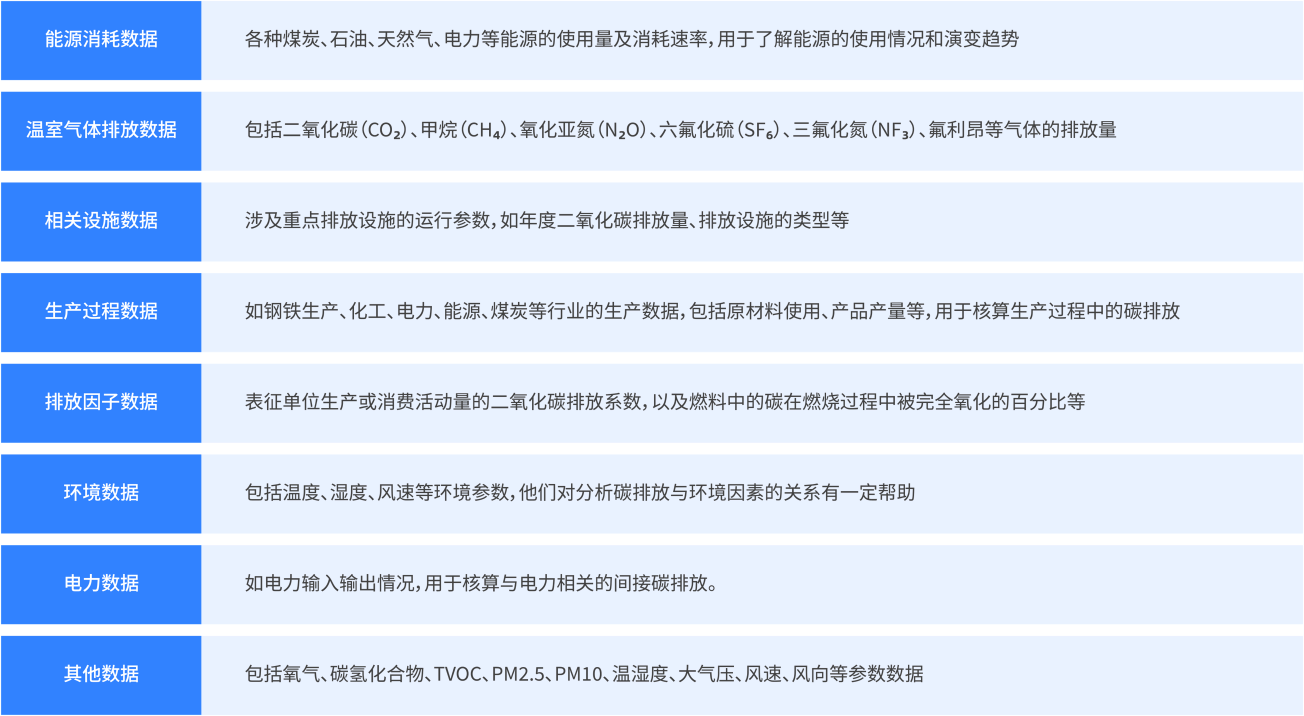
More than 20 types of data require efficient management, including energy consumption data (coal, oil, natural gas, etc.), greenhouse gas emissions data (CO₂, CH₄, N₂O, etc.), production process data, and emission factor data.
Challenges in Data Integration
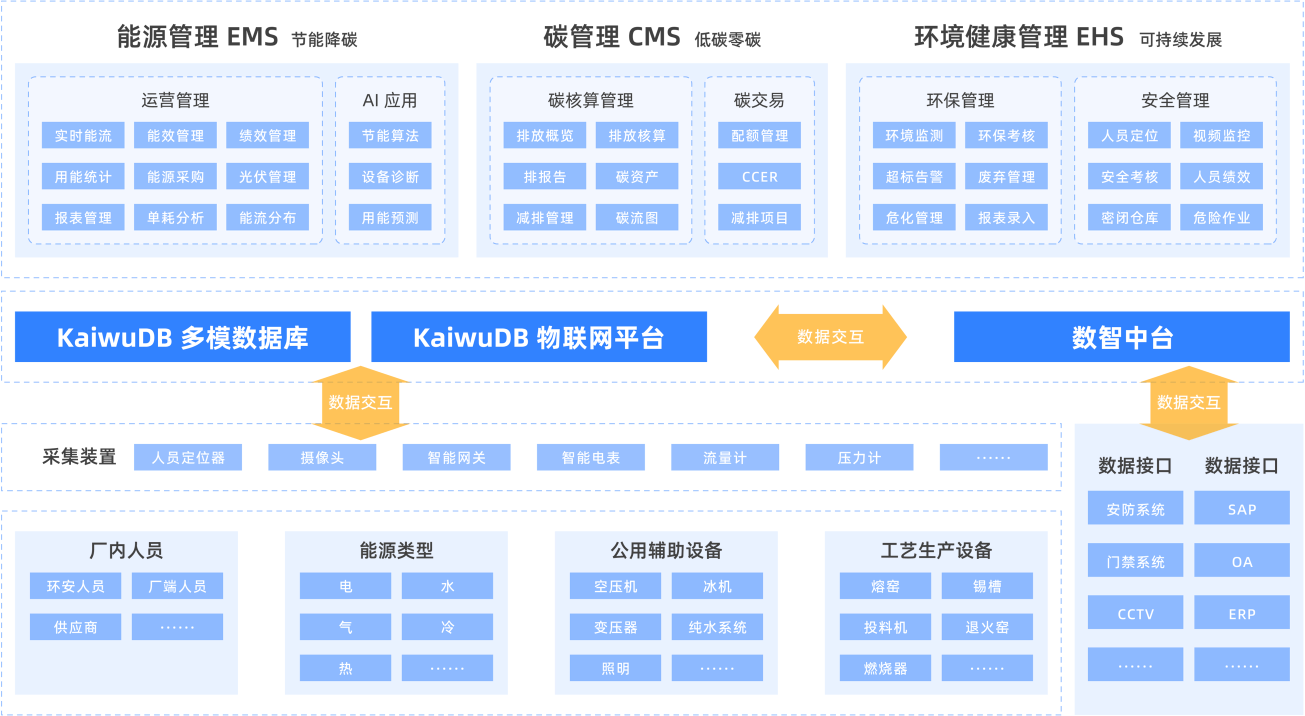
Data from diverse sources, including energy monitoring equipment, sensors and enterprise reports, urgently needs integration to ensure data consistency and comparability.
Challenges in Real-Time Data Processing
Traditional data processing suffers from significant delays, failing to support real-time collection, update of carbon emission data, resulting in untimely dynamic analysis.
Challenges in Data Traceability and Verification
To ensure accurate carbon emission accounting and verification, all data must be fully traceable to guarantee data security, integrity and reliability.

KaiwuDB Solutions
To address the above challenges in carbon data management, we helped customers build an online carbon monitoring system powered by KaiwuDB as the core data foundation. The system collects energy consumption and greenhouse gas emissions data, and conducts analysis and computation based on carbon metrology models. KaiwuDB ensures the system operation stability and supports a lifecycle management of carbon data.
High-Performance Data Processing
KaiwuDB ingests at millions of data points per second and support millisecond-level query, fully meeting the real-time processing requirements of carbon metrology systems, including high-concurrency data read and write.
Intelligent Data Management
Supporting standard SQL and multiple data types, KaiwuDB provides rich aggregate functions and time-interval aggregation. It also supports diversified query capabilities including tag-based query, interpolation query, value filtering, and latest-value query.
Cost-effective Storage
With advanced data compression and down-sampling technologies, KaiwuDB significantly reduces storage costs while ensuring full data integrity.
High-availability Architecture
Through distributed cluster deployment and multi-replica mechanism, KaiwuDB ensures data consistency and security, prevents data loss, and enables full data traceability and verifiability.

Client Benefits
Operation Stability
Since the new monitoring system went online, KaiwuDB has maintained 7×24 stable operation for over 12 months.
Efficient Access to Massive Data
Powered by KaiwuDB, the new system connects more than 10 million carbon metering devices, achieving millisecond-level ingestion for tens of millions of data points.
Breaking Data Silos
The new system has transformed the traditional scattered carbon data management model, effectively solving the problem of unified collection, storage and management across key emitters and sectors. It also fills the gap in provincial-level technical services such as carbon metrology diagnosis and review.
Intelligent Data Analysis
The new system delivers powerful data analysis capabilities, conducting trend analysis and pattern mining on historical data to identify emission trends and correlations, providing a solid data foundation for formulating energy conservation and emission reduction strategies.