Industry Solutions

Smart Metallurgy Solution

Addresses data scenarios across the entire iron-making/steel-making workflow. It provides high-concurrency ingestion, large-scale storage, low-latency queries, and multi-model data integration for massive sensor data generated by smelting equipment every second, while meeting the requirements of cost-effective scalability, high reliability and stability.

Industry Pain Points

Weekness in High Concurrency Data Writing

There are hundreds of sensors on single blast furnace, and the total number of sensors across the plant can reach tens or even hundreds of thousands. Peak data writing often exceeds one million records per second. Traditional databases have limited write performance, which can easily cause data loss and delays. As a result, production status cannot be synchronized in real time, affecting timely process adjustments.

Burden in Storage Cost

Production and equipment operation data must be retained long-term for process optimization and compliance audits, yet such data volume continues to grow at the petabyte level each year. Traditional storage solutions (such as standalone databases with disk arrays) require large hardware investments and offer low compression ratios, leading to high storage costs. In addition, standalone architectures cannot scale horizontally, and expansion requires downtime, which disrupts continuous production.

Low Efficiency in Multi-Dimensional Query and Analysis

The iron-making/steel-making scenarios often require cross-dimensional queries combining time, equipment, process, and quality dimensions. Traditional databases lack optimized time-series engines, resulting in extremely low efficiency for multi-table joins and historical data queries. A single query can take minutes, making real-time process adjustment and fault diagnosis impossible.

Weakness Multi-Source Data Integration and Analysis

In the metallurgy industry, data comes from scattered sources: equipment time-series data, production data, material data, and quality inspection data exist in separate systems with different formats. Traditional solutions struggle to support unified ingestion, model correlation, and collaborative analysis, leading to data silos. Thus prevents data mining and intelligent applications such as predictive maintenance, precise energy management, and full-process quality traceability.

Full-Link Data Processing Solution for Metallurgy

Addressing dense equipment and complex conditions in the metallurgy industry, we build an integrated data foundation centered on KaiwuDB, covering 'edge collection, edge computing, central storage, and cloud analysis.' KaiwuDB natively supports high-concurrency writing and multi-modal data management, efficiently integrating all production line data to provide high-performance digital transformation support.

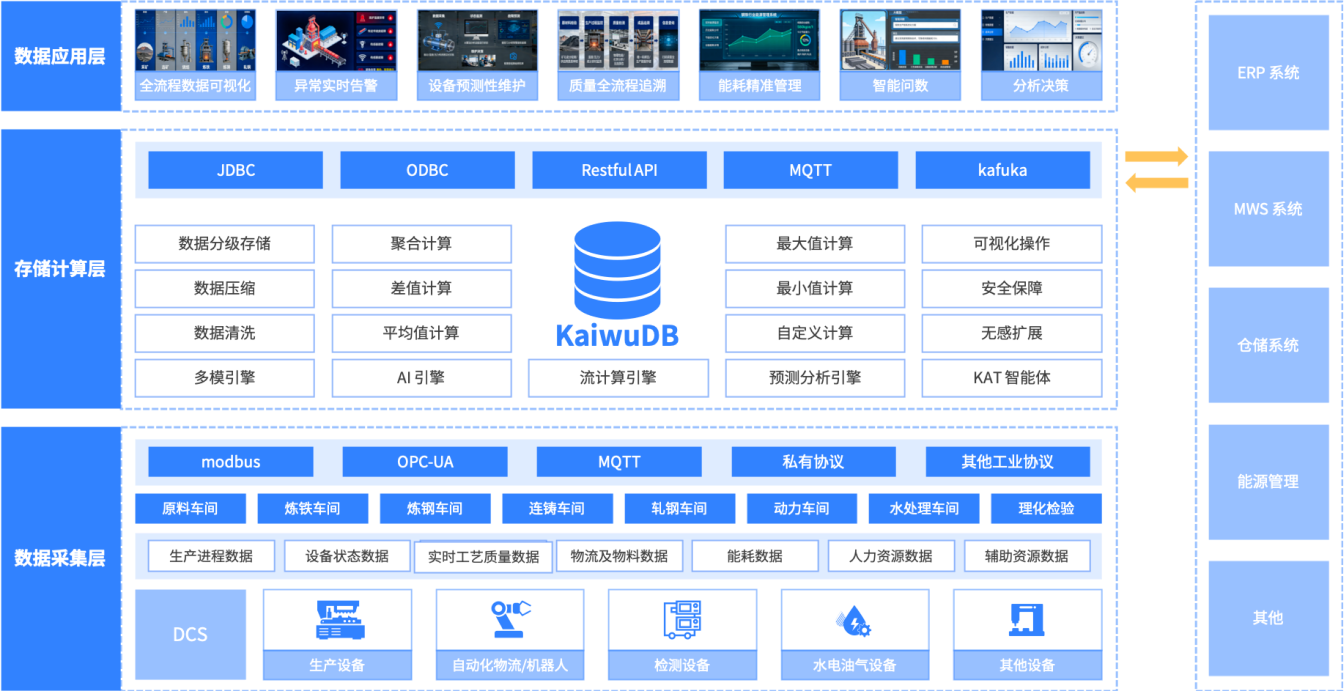
Metallurgy Industry Solution Architecture
1

At the data collection layer, the solution supports a unified ingestion of multi-source data. Through industrial gateways, edge nodes, and APIs, the system collects and preprocesses all-scenario data in real time, including equipment time-series data, production data, quality inspection data, and energy data. It supports protocol parsing and data cleaning to ensure integrity and consistency before transmission to the storage and computing layer.

2

At the storage and computing layer, the solution enables massive storage and efficient computing. Adopting a distributed architecture, KaiwuDB utilizes sharded storage and parallel writing engines to handle high-concurrency time-series data writes, supporting over one million writes per second — meeting peak demands in equipment-intensive metallurgy scenarios while preventing data loss and latency. Columnar storage combined with high-compression algorithms (up to 30:1) significantly reduces storage costs for PB-scale historical data. Multi-dimensional integrated computing allows correlation modeling between time-series data and structured business data. With high-reliability distributed deployment, KaiwuDB supports automatic failover, eliminating single points of failure and ensuring data continuity and service availability. Through standardized interfaces, it provides unified data services and pushes analysis results to upstream applications, simplifying business system development.

3

At the data application layer: the solution enables a full-scenario intelligent applications. Based on KaiwuDB, the solution achieves real-time production monitoring, predictive equipment maintenance, full-process quality traceability, precise energy consumption control, and process parameter optimization. By analyzing historical data, it identifies optimal process combinations to improve production efficiency and product qualification rates.

Solution Value

Efficiency Improvement: Supporting Real-Time Decision-Making and Intelligent Optimization

KaiwuDB’s high-concurrency writing ensures real-time collection of production data without backlogs. Its low-latency queries(real-time data responses within millisecond and historical data retrieval within seconds) support real-time decision-making for process adjustment and fault early warning. Multi-dimensional integrated analysis unlocks data value, helping optimize process parameters and predict equipment failures in advance.

Cost Optimization: Reducing Storage and Database Operations Expenses

KaiwuDB’s high compression ratio reduces storage costs for massive time-series data by 30%–50%. Tiered storage of hot and cold data further optimizes the cost structure. The distributed architecture supports horizontal scaling and automated O&M, enabling non-stop expansion, reducing manual O&M workload, and lowering system upgrade risks.

Empower Busuiness: Building a Full-Link Digital Closed Loop

With KaiwuDB as the core, the solution realizes unified management and integrated analysis of multi-source data including equipment, production, quality and energy consumption. It empowers intelligent applications across production monitoring, equipment maintenance, quality traceability and energy management, driving the metallurgy industry to transform from experience-driven to data-driven operations.

Stability and Reliability: Ensuring Continuous Production

KaiwuDB provides high availability and data reliability. Master-slave replication and automatic failover mechanisms eliminate single points of failure. Data persistence and backup strategies prevent data loss. The system fully meets the strict 7×24 continuous production requirements of the metallurgy industry, offering stable support for digital transformation.

Unlock Your High-Performance IoT Data Management Experience with One Click