Customer Cases / Energy & Power

An Energy Service Company of State Grid

Distributed Energy Storage Edge-to-Cloud Integration

Contact Us
85%+ energy efficiency improvement
Edge-to-cloud collaboration
Intelligent decision-making

Business Background

With national focus and support for the renewable energy industry, massive time-series data plays a key role in improving energy storage efficiency and ensuring safe, stable energy operation. The energy service company requires a specialized time-series data solution for distributed energy storage scenarios. This solution enables large-scale aggregation and coordinated control of distributed energy, enhancing grid security and operational stability. It also improves the grid’s capacity to accommodate large-scale and distributed renewable energy, while supporting diversified services including peak, frequency and voltage regulation.

Data Challenges

Time-series data collection, cloud-edge collaboration, and analysis & monitoring face major tests in distributed energy storage scenarios

01

Lack of Edge-to-Cloud Integration Solution

With over 50 distributed sites across regions, our customer requires unified management of data related to energy consumption, energy storage equipment, and battery module status. Dispersed data cannot be effectively aggregated or analyzed, requiring an efficient edge-to-cloud integration solution.

02

High Requirements for Time-series Data Collection

The system needs to collect time-series data from nearly 100 RK3568 industrial PCs across 50+ sites. Each device supports 20,000–50,000 data points, with a total of over 1 million points, placing high demands on time-series data collection.

03

High Cost of Energy Data Analysis

The original CDH-based data analysis system involves excessive components, difficult maintenance and high hardware costs, making it unable to process massive time-series data efficiently.

04

Lack of Effective Monitoring for Massive Equipment

There is insufficient functions for running status monitoring of batteries, fans, air conditioners and other devices. Diverse data modeling capabilities are required for prediction and fault diagnosis to identify issues and optimize maintenance.

KaiwuDB Solution

1
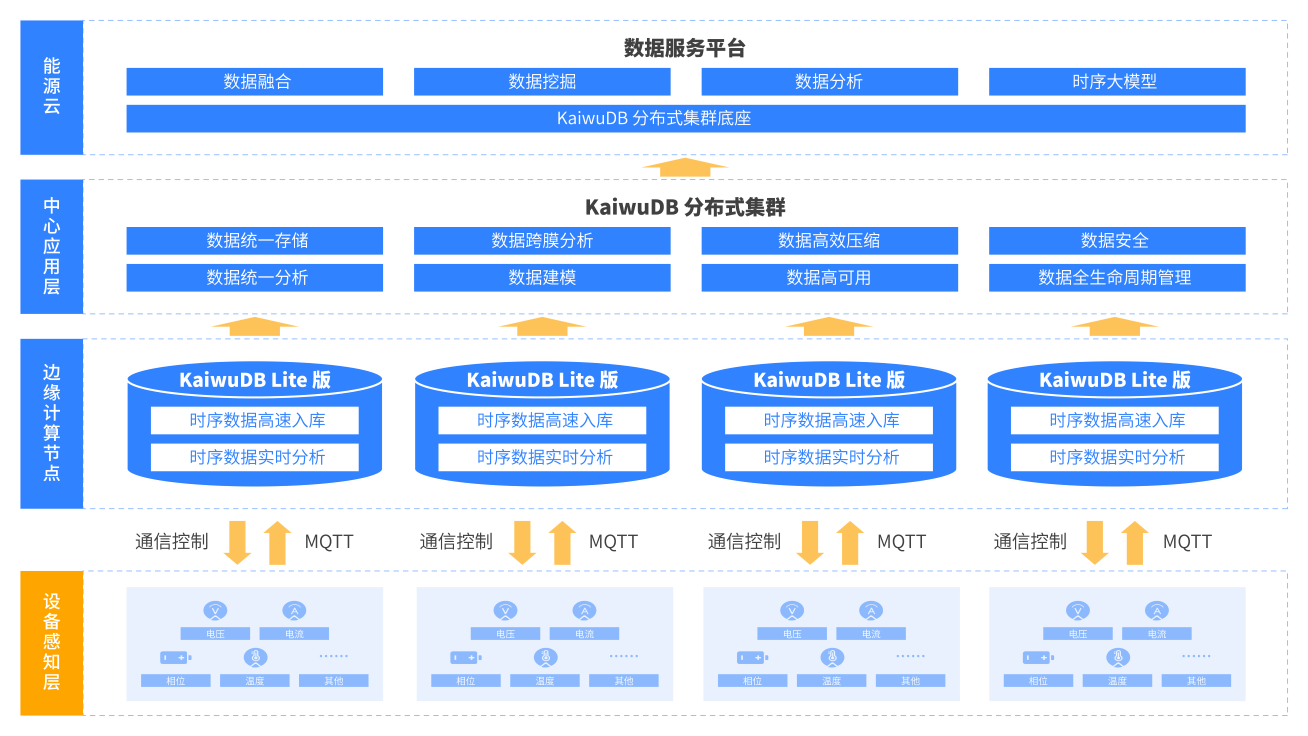
On the edge, KaiwuDB adapts to a large number of industrial PCs and deployed standalone, enabling an unified collection and management of time-series data (including sensor data such as temperature and humidity, power data such as battery status, and device control status such as air conditioners), as well as relational data such as device information and business data. It supports efficient collection, storage, and short-term retention of over one million monitoring points, and enables real-time local data analysis.
2
On the system side, KaiwuDB cluster is deployed to aggregate massive time-series data from more than 50 sites. With built-in functions, it supports the construction of diverse data models, achieving unified data aquisition and analysis.
3
A distributed KaiwuDB cluster is deployed on the cloud and integrated with our data platform. It provides time-series large model and agent capabilities to support efficient, intelligent, and in-depth data analysis and mining, realizing efficient data utilization and application.
Edge-to-Cloud Integrated Architecture

Client Benefits

Energy Efficiency Improved

KaiwuDB ingests at millions of data points per second and supports millisecond-level data computing and analysis, thereby reducing decision latency in energy storage scenarios and enhancing the overall grid regulation capability of energy storage cabinets. It further optimizes peak regulation, power smoothing, frequency regulation, and distribution congestion mitigation. Energy efficiency is improved by over 85%, the charge-discharge conversion speed is within 100 ms, and hardware investment costs are reduced by 80%.

Equipment Utilization Enhanced

KaiwuDB enables the cross-model computing and analysis of time-series data (production, equipment status) and relational data (asset, business). Based on the results of equipment utilization and energy efficiency analysis, we help our customer to optimize scheduling, improve utilization, and extend equipment service life.

Edge-to-Cloud Deployment for Unified Data Management

KaiwuDB operates stably on the edge with memory usage below 50% and CPU usage under 50%. Through data publish-subscribe capabilities, it synchronizes data between edge and central system, supports unified storage and complex analysis, and provides APIs for cloud applications, achieving data integration and management.

Offering In-Depth Monitoring and Intelligent Decision-Making

KaiwuDB provides time slicing, data slicing, windowing and other built-in functions, enabling users to easily build analysis models and quickly locate faults in batteries, air conditioners, and energy-consuming equipment. Stream computing supports real-time calculation and continuous queries to meet real-time energy efficiency analysis. Combined with data pub-sub, APIs and BI reports, it realizes data visualization and supports comprehensive monitoring and intelligent decision-making.

Unlock Your High-Performance IoT Data Management Experience with One Click