KaiwuDB
Why KaiwuDB?
High-Performance Time-Series Data Processing
With 'In-data computing' as a core technique, KaiwuDB allows a concurrent data writing for tens of millions of devices, reads up to ten millions records in one second and supports milli-second level precise data writing. On benchANT(Time Series: DevOps), a globally recognized database performance ranking based on the TSBS (Time Series Benchmark Suite) DevOps workload, KaiwuDB once refreshed the existing records in metrics such as write throughput, query throughput, query latency, and cost-effectiveness. And now still remain the top position on this global performance ranking in xSmall instance configurations.
Innovative Multi-model Architecture
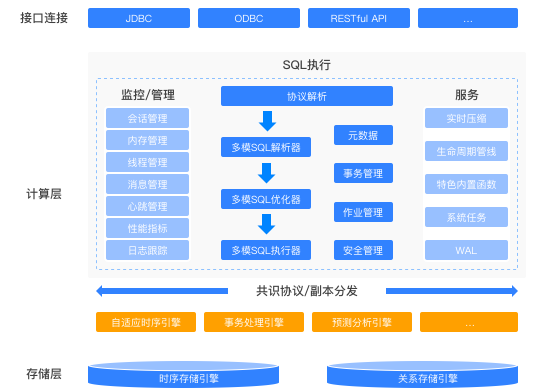
KaiwuDB's multi-model architecture integrates adaptive time-series engines, TP(transaction processing) and AP(analytics processing) engine. Within a single, unified database system, KaiwuDB presents a consolidated solution by natively supporting multiple data models—such as time-series and relational, and this 'One-database, Multi-capability' paradigm directly addresses the architectural redundancy of traditional database deployment.
Distributed Database Architecture
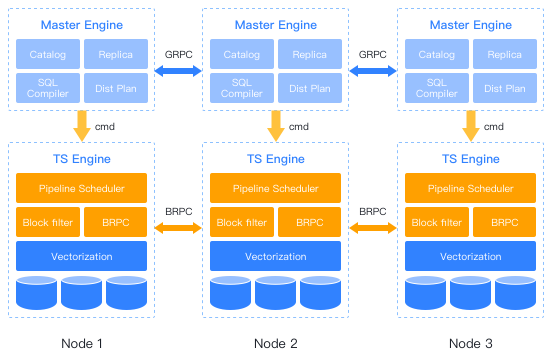
KaiwuDB employs a fully decentralized architecture to eliminate single points of failure. It supports online horizontal scaling, while performance improves linearly as nodes add in PB-level data volume scenarios. By adopting multi-replication and the Raft Protocol, it achieves automatic failure recovery. Additionally, it supports flexible configuration of single or multiple replicas to ensure availability in diverse application scenarios.
Cost-Effective Storage
KaiwuDB saves storage costs with three core technologies. First, its proprietary algorithm can reach a compression ratio between 5:1 and 30:1, thus reducing the storage space for time-series data by up to 90%; second, KaiwuDB enables full-lifecycle data management, with automatic cleanup of expired data to cut storage costs; third, KaiwuB implements tiered storage of time-series data based on Time-based Data Hotness —— the system automatically migrates cold data (long-stored and infrequently accessed) to low-cost storage media, while keeping hot data (newly generated and frequently accessed) in high-performance storage, striking an optimal balance between performance and costs.
Native AI
KaiwuDB natively integrates AI analytics capabilities into the database kernel and provides pluggable AI analytics and prediction functions, supporting the full lifecycle of model import, training, prediction, evaluation and replacement. It is compatible with mainstream machine learning frameworks and has a built-in time-series foundational large model. Real-time analytics and prediction can be completed within the database without exporting data to third-party AI platforms, highlighting the core value of 'Data for Analytics, and Analytics for Decision-making'.
Security, Stability and Compliance
KaiwuDB has built a comprehensive security system covering identity authentication, permission management, access control, data storage and transmission encryption, and security audit, meeting the compliance requirements of key industries such as manufacturing, energy, power and IoV(Internet of Vehicles).
Core Features
Cross-model Data Processing
With a unified database kernel, KaiwuDB enables an integrated data processing of structured data(e.g. Time-series and relational data), semi-structured and un-structured data, breaking away from siloed data systems caused by complicated business systems.
- Unified SQL interface for cross-model data queries.
- A single, unified database system that integrates adaptive time-series engines, TP(transaction processing) and AP(analytics processing) engine, supporting combined storage of time-series data, relational data and more.
- Eliminates the architectural redundancy of traditional database deployment while enables real-time data aggregation without ETL(Extraction Transformation Loading).

High-performance Data Processing
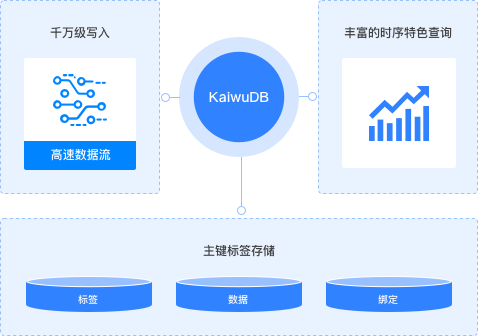
For time-series data scenarios, KaiwuDB has independently developed the Primary Key Tag Mechanism——use built-in time-series feature functions to improve database reading and writing performance. Combined with core techniques namely In-data Computing and Data Reorganization, this mechanism allows second-level data query over hundreds of millions time-series data.
- Efficient Data Writing: KaiwuDB supports standard SQL writing and data writing in batch or schemaless modes. In-data Computing and other core techniques further improve data throughput.
- High-speed Data Query and Analytics: KaiwuDB provides rich time-series query capabilities including the latest value query, interpolation query and downsampling query, while supports window splitting query, multi-table relational query, group aggregated query and cross-model query in data analysis scenarios.

Data Distribution
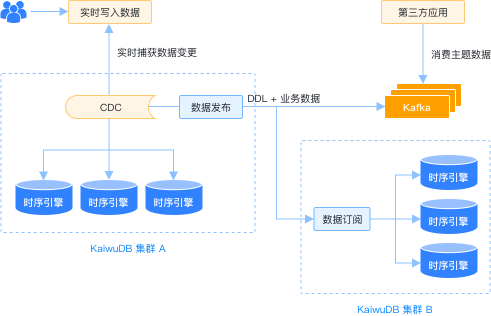
The data distribution feature includes data push and data pub/sub, which allows a database, a table or even a SQL query result to be published to Kafka or another KaiwuDB instance for data sharing and synchronization.
- Support full-database and full-table initial loading.
- Support row filtering and column projection based on SQL conditions.
- Support real-time CDC(Change Data Capture).
- Support breakpoint resumption during failure recovery to avoid data duplication or loss.

Stream Computing
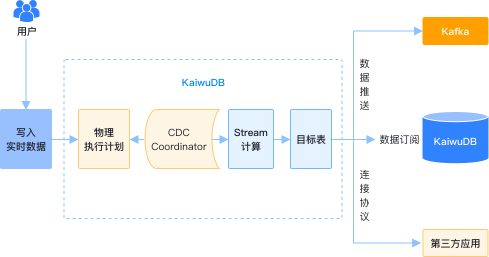
Built-in ready-to-use stream computing allows users to define tasks using standard SQL. When data is written into the source table, it is automatically processed according to defined rules (including computing logic and filter conditions) and written into the target table. This feature reduces complexity and O&M costs of traditional systems, and can be used for intelligent down-sampling and precomputing acceleration to improve query speed significantly.
- Support breakpoint resumption.
- Support processing strategies for expired data, historical data and out-of-order data.
- The target tables can be both relational and time-series mode.

edge-to-cloud Collaboration
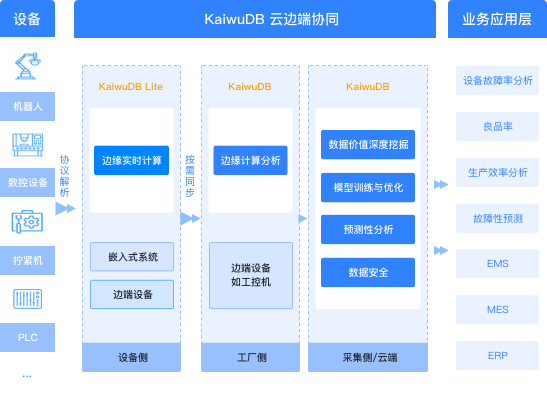
KaiwuDB builds a complete edge-to-cloud collaborative system together with KaiwuDB Lite, which is developed for resource-constrained devices or embedded systems. With its lightweight architecture and high compression capability, KaiwuDB Lite realizes real-time collection, processing, storage and query of massive time-series data from sensors and devices. Meanwhile, KaiwuDB can be deployed on the edge or cloud to centrally integrate and analyze data collected from endpoints, supporting real-time decision-making, operation monitoring and early warning, business insight and more.

AI Agent
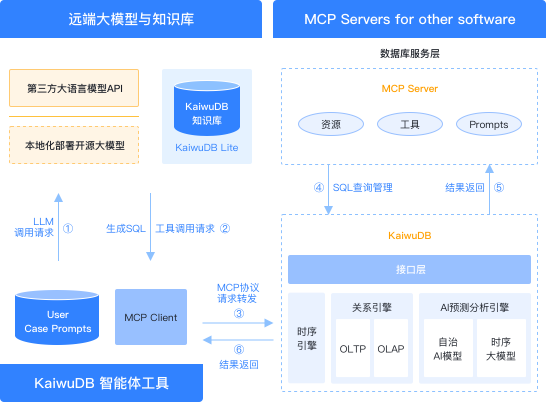
Built on the Model Context Protocol (MCP), KaiwuDB AI Agent deeply integrates NLP and database technologies. With KaiwuDB AI Agent, users can complete intelligent Q&A, automated deployment, natural language query and analytics, fault diagnosis and database performance tuning through simple conversations. Combining the intelligent prompt of LLMs with knowledge base and vector search, the AI Agent can reduce the learning, usage, and operation & maintenance costs of KaiwuDB, and improve the efficiency of data interaction.
- Intelligent Inspection: regularly inspects database status, storage capacity and slow SQL, shifting from “post-failure intervention” to 'pre-warning'.
- Performance Optimization: identifies performance bottlenecks, provides analysis reports and generates optimization plans.
- Data Management and Analytics: realizes data query by natural language and business prediction through data analysis.

Innovative Technologies
Time-Series Execution Engine