User Management
CREATE USER
The CREATE USER statement creates a user and sets one or more options for the user. Each statement creates only one user. By default, the new user supports LOGIN options.
Privileges
The user must have the CREATEROLE option or be a member of the admin role. By default, the root user belongs to the admin role.
Syntax
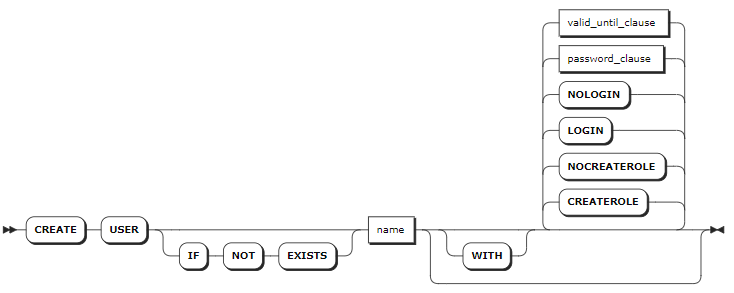
valid_until_clause
password_clause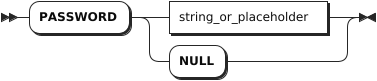
Parameters
| Parameter | Description |
|---|---|
IF NOT EXISTS | Optional. - When the IF NOT EXISTS keyword is used, the system creates a new user only if a user of the same name does not already exist. Otherwise, the system fails to create a new user without returning an error. - When the IF NOT EXISTS keyword is not used, the system creates a new user only if a user of the same name does not already existed. Otherwise, the system fails to create a new user and returns an error. |
name | The name of the user to create. The user name is case-insensitive and follows these rules: - Start with a letter or an underscore ( _). - Contain letters, numbers, or underscore ( _). - Must be 1 - 63 characters in length. |
CREATEROLE | Allow the new user to create, change, and drop other non-admin users. By default, do not set this option when creating a user. |
NOCREATEROLE | Disallow the new user to create, change, and drop other non-admin users. By default, this option is set when creating a user. |
LOGIN | Allow the new user to log in to the KWDB server. By default, this option is set when creating a user. |
NOLOGIN | Disallow the new user to log in to the KWDB server. By default, do not set this option when creating a user. |
PASSWORD <password> | Set the password for the user. The password can also be set to NULL. The user with this option can access to a secure cluster with the password. The password should be entered as a string literal, enclosed in single quotes (' '). By default, do not set this option when creating a user. |
VALID UNTIL <date_time> | Set the date and time (in the timestamp format) after which the password is not valid. It can also be set to NULL. It is enclosed in single quotes (' '). When you log in to the KWDB database through a CLI tool, you can check the expiration time of the password. By default, do not set this option when creating a user. |
Examples
Create a user with default options. By default, a new user cannnot create a role but can log in to the KWDB server.
CREATE USER user1;
CREATE USER
Create a user with the
CREATEROLEoption.CREATE USER user2 WITH CREATEROLE; CREATE USERCreate a user with the
NOLOGINoption.CREATE USER user3 WITH NOLOGIN; CREATE USERCreate a user and set the password and expiration time for the user.
CREATE USER user4 WITH PASSWORD '11aa!!AA' VALID UNTIL '2023-01-01 00:00:00+00:00';
CREATE USER
SHOW USERS
The SHOW USERS or SHOW ROLES statement lists all created users for a database.
Privileges
The user must have been granted the SELECT privilege on the system.users and system.role_members system table.
Syntax

Parameters
N/A
Examples
This example lists all created users for a database.
SHOW USERS;
If you succeed, you should see an output similar to the following:
username|options                              |member_of
--------+-------------------------------------+---------
admin   |CREATEROLE                           |{}
root    |CREATEROLE                           |{admin}
user1   |CREATEROLE                           |{}
user2   |CREATEROLE                           |{}
user3   |VALID UNTIL=2023-01-01 00:00:00+00:00|{}
ALTER USER
The ALTER USER statement changes one or more options for a user. Each statement changes only one user.
Privileges
The user must have the CREATEROLE option or be a member of the admin role. By default, the root user belongs to the admin role.
Syntax
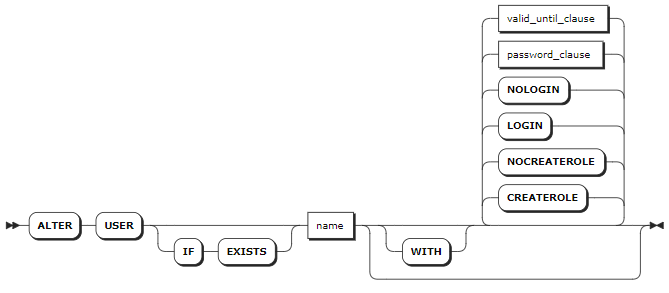
password_clausevalid_until_clause
Parameters
| Parameter | Description |
|---|---|
IF EXISTS | Optional. - When the IF EXISTS keyword is used, the system changes a user only if the target user has already existed. Otherwise, the system fails to change the user without returning an error. - When the IF EXISTS keyword is not used, the system changes a user only if the target user has already existed. Otherwise, the system fails to change the user and returns an error. |
name | The name of the user to change. The user name is case-insensitive and follows these rules: - Start with a letter or an underscore ( _). - Contain letters, numbers, or underscore ( _). - Must be 1 - 63 characters in length. |
CREATEROLE | Allow the new user to create, change, and drop other non-admin users. By default, do not set this option when creating a user. |
NOCREATEROLE | Disallow the new user to create, change, and drop other non-admin users. By default, this option is set when creating a user. |
LOGIN | Allow the new user to log in to the KWDB server. By default, this option is set when creating a user. |
NOLOGIN | Disallow the new user to log in to the KWDB server. By default, do not set this option when creating a user. |
PASSWORD <password> | Set the password for the user. The password can also be set to NULL. The user with this option can access to a secure cluster with the password. The password should be entered as a string literal, enclosed in single quotes (' '). By default, do not set this option when creating a user. |
VALID UNTIL <date_time> | Set the date and time (in the timestamp format) after which the password is not valid. It can also be set to NULL. It is enclosed in single quotes (' '). When you log in to the KWDB database through a CLI tool, you can check the expiration time of the password. By default, do not set this option when creating a user. |
Examples
Set a user with the
NOCREATEROLEoption.-- 1. Check user options. SHOW USERS; username | options | member_of -----------+---------------------------------------+------------ admin | CREATEROLE | {} root | CREATEROLE | {admin} user1 | | {} user2 | CREATEROLE | {} user3 | NOLOGIN | {} user4 | VALID UNTIL=2023-01-01 00:00:00+00:00 | {} (6 rows) -- 2. Set user2 with the NOCREATEROLE option. ALTER USER user2 WITH NOCREATEROLE; ALTER USER -- 3. Check user options. SHOW USERS; username | options | member_of -----------+---------------------------------------+------------ admin | CREATEROLE | {} root | CREATEROLE | {admin} user1 | | {} user2 | | {} user3 | NOLOGIN | {} user4 | VALID UNTIL=2023-01-01 00:00:00+00:00 | {} (6 rows)Modify the password and expiration time for a user.
-- 1. Modify the password and expiration time for user4.

ALTER USER user4 WITH PASSWORD '11aa!!AA' VALID UNTIL '2023-01-01 00:00:00+00:00';
ALTER USER

-- 2. Check user options.

SHOW USERS;
  username |                    options                     | member_of
-----------+------------------------------------------------+------------
  admin    | CREATEROLE                                     | {}
  root     | CREATEROLE                                     | {admin}
  user1    |                                                | {}
  user2    |                                                | {}
  user3    | NOLOGIN, VALID UNTIL=2023-12-31 00:00:00+00:00 | {}
  user4    | VALID UNTIL=2023-01-01 00:00:00+00:00          | {}
(6 rows)
DROP USER
The DROP USER statement removes one or more usres.
Privileges
The user must have the CREATEROLE option or be a member of the admin role. By default, the root user belongs to the admin role.
Syntax

Parameters
| Parameter | Description |
|---|---|
IF EXISTS | Optional. - When the IF EXISTS keyword is used, the system removes a user only if the target user has already existed. Otherwise, the system fails to remove the user without returning an error. - When the IF EXISTS keyword is not used, the system removes a user only if the target user has already existed. Otherwise, the system fails to remove the user and returns an error. |
name | A comma-separated list of user names to remove. |
Examples
This example removes a user named user1.
DROP USER user1;