Cluster Settings
SET CLUSTER SETTING
The SET CLUSTER SETTING statement modifies a cluster-level setting.
Note
Many cluster settings are intended for tuning KWDB internals. Before changing these settings, it is strongly recommended to think about your goals with KWDB. Otherwise, you use them at your own risk.
Privileges
The user must be a member of the admin role. By default, the root user belongs to the admin role.
Syntax

Parameters
| Parameter | Description |
|---|---|
var_name | The name of the cluster setting (case-insensitive). |
var_value | The value for the cluster setting. |
DEFAULT | Reset the cluster setting to its default value. |
Examples
Set a value for a single cluster setting.
SET CLUSTER SETTING audit.enabled = true;Reset a cluster setting to its default value.
SET CLUSTER SETTING audit.enabled = default;
SHOW CLUSTER SETTING
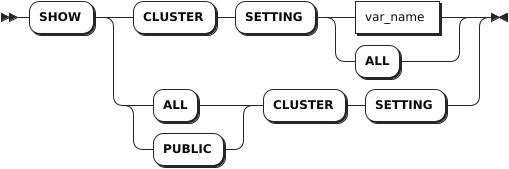
The SHOW CLUSTER SETTING statement displays the values of cluster settings.
Privileges
The user must be a member of the admin role. By default, the root user belongs to the admin role.
Syntax
Note
The SHOW CLUSTER SETTING statement is unrelated to the following SHOW statements:
SHOWSHOW CREATE DATABASESHOW CREATE TABLESHOW CREATE VIEWSHOW USERSSHOW DATABASESSHOW COLUMNSSHOW GRANTSSHOW CONSTRAINTS
Parameters
| Parameter | Description |
|---|---|
var_name | The name of the cluster setting (case-insensitive). |
Examples
Show the value of a single cluster setting.
SHOW CLUSTER SETTING audit.enabled;
  audit.enabled
-----------------
      false
(1 row)
Show the values of all cluster settings.
SHOW ALL CLUSTER SETTINGS;
variable                                                 |value                                            |setting_type|public|description
---------------------------------------------------------+-------------------------------------------------+------------+------+------------------------------------------------------------------------------------------------------
audit.enabled                                            |false                                            |b           |f     |the switch of audit
audit.log.enabled                                        |true                                             |b           |f     |the switch of audit log file record
bulkio.replication_ingestion.apply_txn_interval          |1s                                               |d           |t     |the timestamp interval of apply txn
bulkio.replication_ingestion.cutover_signal_poll_interval|30s                                              |d           |f     |the interval at which the stream ingestion job checks if it has been signaled to cutover
bulkio.replication_ingestion.minimum_flush_interval      |1s                                               |d           |t     |the minimum timestamp between flushes; flushes may still occur if internal buffers fill up
bulkio.replication_recv.apply_txn_interval               |1s                                               |d           |t     |the timestamp interval of apply txn
bulkio.replication_recv.cutover_signal_poll_interval     |30s                                              |d           |f     |the interval at which the stream recv job checks if it has been signaled to cutover
bulkio.replication_recv.minimum_flush_interval           |1s                                               |d           |t     |the minimum timestamp between flushes; flushes may still occur if internal buffers fill up
...
sql.stats.automatic_collection.min_stale_rows            |500                                              |i           |t     |target minimum number of stale rows per table that will trigger a statistics refresh
sql.stats.histogram_collection.enabled                   |true                                             |b           |t     |histogram collection mode
sql.stats.max_timestamp_age                              |5m0s                                             |d           |f     |maximum age of timestamp during table statistics collection
sql.stats.post_events.enabled                            |false                                            |b           |t     |if set, an event is logged for every CREATE STATISTICS job
sql.stmt_diagnostics.bundle_chunk_size                   |1.0 MiB                                          |z           |f     |chunk size for statement diagnostic bundles
sql.stmt_diagnostics.poll_interval                       |10s                                              |d           |f     |rate at which the stmtdiagnostics.Registry polls for requests, set to zero to disable
sql.tablecache.lease.refresh_limit                       |50                                               |i           |f     |maximum number of tables to periodically refresh leases for
sql.tag_filter_parallel.enabled                          |false                                            |b           |t     |tag screen parallel
sql.tag_value_cache.enabled                              |true                                             |b           |f     |enable the tag value cache
sql.temp_object_cleaner.cleanup_interval                 |30m0s                                            |d           |t     |how often to clean up orphaned temporary objects
sql.template_table_limit.enabled                         |true                                             |b           |t     |template table limit
sql.testing.mutations.max_batch_size                     |0                                                |i           |f     |the max number of rows that are processed by a single KV batch when performing a mutation operation (0=default)
sql.testing.vectorize.batch_size                         |0                                                |i           |f     |the size of a batch of rows in the vectorized engine (0=default, value must be less than 4096)
sql.trace.log_statement_execute                          |false                                            |b           |t     |set to true to enable logging of executed statements
sql.trace.session_eventlog.enabled                       |false                                            |b           |t     |set to true to enable session tracing. Note that enabling this may have a non-trivial negative performance impact.
sql.trace.txn.enable_threshold                           |0s                                               |d           |t     |duration beyond which all transactions are traced (set to 0 to disable)
sql.workload_cache.buffer                                |1.0 GiB                                          |z           |f     |max size of workload info cache
sql.workload_cache.save.interval                         |10s                                              |d           |f     |interval for kwbasedb to fall disk
sql.workloadinfo.application_name_list                   |                                                 |s           |f     |set workload info application_name_list
sql.workloadinfo.enabled                                 |false                                            |b           |f     |enable the workload info collection
sql.workloadinfo.maxcollectnum                           |10                                               |i           |f     |max collecting num of workload info collection
sql.workloadinfo.tenant_portal_name_list                 |                                                 |s           |f     |set workload info tenant_portal_name_list
sql.workloadinfo.user_name_list                          |                                                 |s           |f     |set workload info user_name_list
stream_replication.job_checkpoint_frequency              |10s                                              |d           |f     |controls the frequency with which partitions update their progress; if 0, disabled
stream_replication.job_checkpoint_frequency_single       |10s                                              |d           |f     |controls the frequency with which partitions update their progress; if 0, disabled
template_table.precomputing.match.concurrent.enabled     |false                                            |b           |f     |can concurrent match precomputing of template table
testing.system_namespace_migration.enabled               |true                                             |b           |f     |internal testing only: disable the system namespace migration
timeseries.storage.enabled                               |true                                             |b           |t     |if set, periodic timeseries data is stored within the cluster; disabling is not recommended unless you are storing the data elsewhere
timeseries.storage.resolution_10s.ttl                    |240h0m0s                                         |d           |t     |the maximum age of time series data stored at the 10 second resolution. Data older than this is subject to rollup and deletion.
timeseries.storage.resolution_30m.ttl                    |2160h0m0s                                        |d           |t     |the maximum age of time series data stored at the 30 minute resolution. Data older than this is subject to deletion.
timeseries.trace.on_off_list                             |                                                 |s           |f     |collection/push switch
trace.debug.enable                                       |false                                            |b           |t     |if set, traces for recent requests can be seen in the /debug page
trace.lightstep.token                                    |                                                 |s           |t     |if set, traces go to Lightstep using this token
trace.zipkin.collector                                   |                                                 |s           |t     |if set, traces go to the given Zipkin instance (example: '127.0.0.1:9411'); ignored if trace.lightstep.token is set
version                                                  |20.1                                             |m           |t     |set the active cluster version in the format '<major>.<minor>'
(223 rows)
RESET CLUSTER SETTING
The RESET CLUSTER SETTING statement resets a cluster setting to its default value.
Privileges
The user must be a member of the admin role. By default, the root user belongs to the admin role.
Syntax

Parameters
| Parameter | Description |
|---|---|
var_name | The name of the cluster setting (case-insensitive). |
Examples
This example resets the audit.enabled cluster setting to its default value.
RESET CLUSTER SETTING audit.enabled;